If the Answer Is Free, What Are You Still Good For?

Imagine this. You type a question into your phone. Three seconds later you have the answer. Free. For almost any question.
That is not the future. That is now.
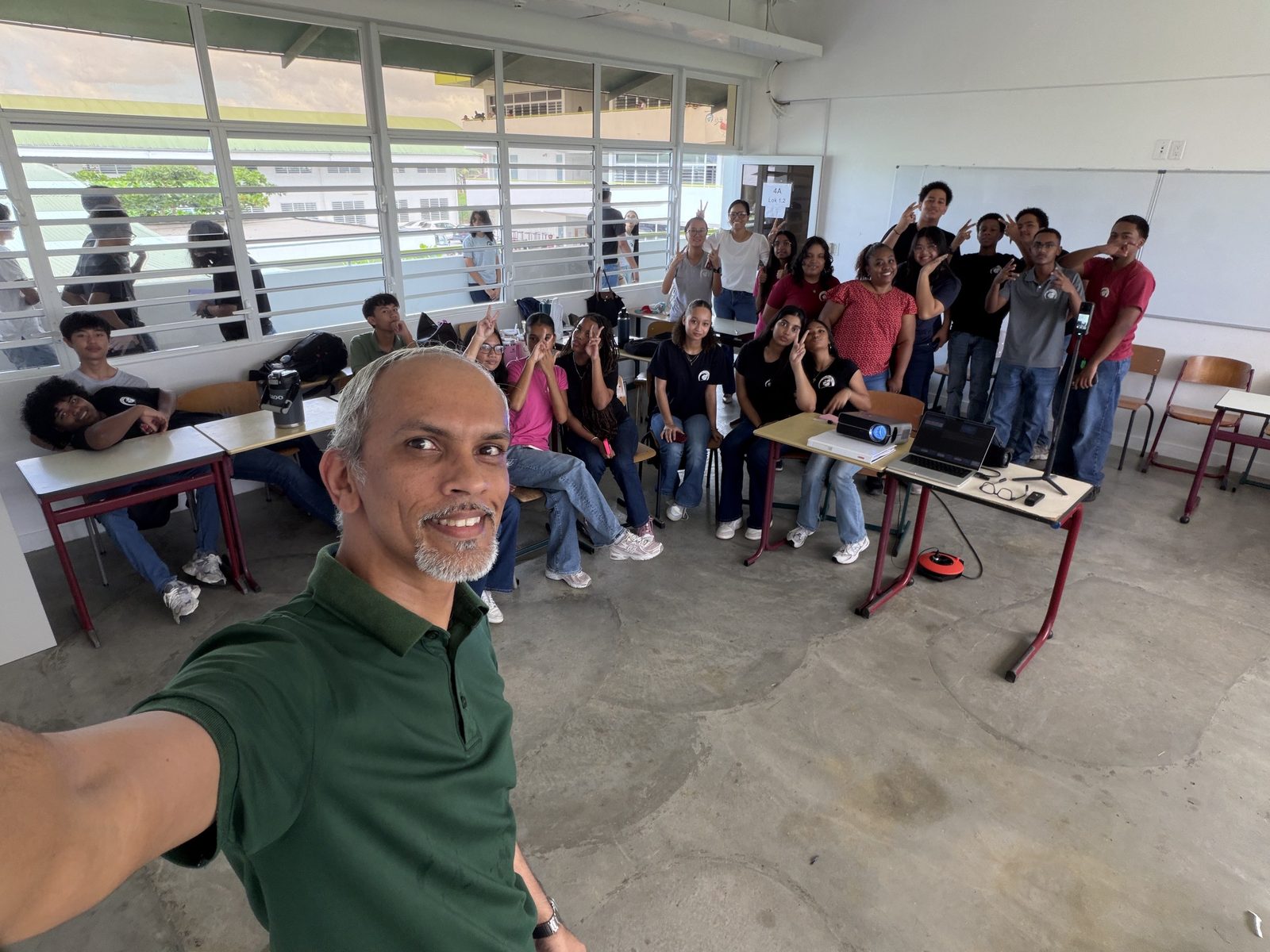
That is how I opened my talk for the students of the Nassy Brouwer College. And it is why I gave them one question to take home:
If the answer is free, what are YOU still good for?
I did not come to preach. I came to show them two things I found confronting myself, and then to look at their future together. Here is what I shared.
Two hands in the air
I started by asking for hands. Teachers too.
Who used AI in the past week? Almost everyone. That did not surprise me. So I did not explain what a chatbot is. They already know.
Who thinks you learn more when AI helps you? Many hands again. I asked them to remember that, because we would come back to it.
The whole idea on one slide
Knowledge used to be scarce. Whoever had the answer had the power. The doctor knew. The lawyer knew. The teacher knew.
Now anyone with a phone can get an answer. Free. In seconds.
So what becomes expensive? Three things:
- The right question. Whoever knows what to ask, wins.
- The right judgment. AI always sounds certain. Someone has to see whether it is correct.
- The responsibility. When it goes wrong, nobody asks the chatbot to explain. You put your name under it.
I was clear with the students: this is my vision, not a research result. So I showed them why I see it this way, with an experiment.
The experiment: practise with ChatGPT, or on your own?
Researchers from the University of Pennsylvania ran a study in Turkey with almost a thousand students in grades nine to eleven. Roughly the age of the students in front of me.
Two groups got the same maths practice problems. Group A practised the old way: book, notebook, their own head. Group B was allowed to use ChatGPT. Afterwards everyone took the same test, without any help.
I asked the room to vote. Who scores highest, A or B?
Here is what happened.
- During practice, the ChatGPT group solved 48 percent more problems correctly. That feels like winning. The answer is there, it is right, next.
- On the test, without ChatGPT, they scored 17 percent worse than the group that practised on its own.
One group looked better while practising. The other group had actually learned something.
Most of the room had voted B. No shame in that. Almost everyone chooses B.
There was also a third group, with an AI tutor that only gave hints. That group solved 127 percent more problems during practice. On the test, they did no better than the students who practised on their own. Not worse. But not better either.
I have to be honest about the limits. This is one experiment. Maths, in Turkey. And it was a draft paper, not yet reviewed by other researchers when I read it.
It is also exactly why teachers are careful with AI. They have a point, and this experiment gives them one.
The real danger: you do not feel it
For me this is the most important part.
After the study, the researchers asked the students whether ChatGPT had reduced their learning. The students said no. The test scores said yes.
So the danger is not that you get worse. The danger is that you do not feel it.
Think of a pilot on autopilot. The plane flies fine. Until the day the autopilot fails, and you no longer know how to fly it yourself.
So, back to the second question. Do you learn more with AI? You can. But only if you use it well. More on that below.
AI sounds equally sure when it is wrong
The researchers also looked at ChatGPT itself. How often did it get the problems right?
About half the time. In 42 percent of cases the approach was wrong. In 8 percent there was a calculation error.
What strikes me is this: when you read the answer, the right and the wrong ones look the same. Same tone. Same confidence.
To be fair, this was a version of ChatGPT from autumn 2023. The models have improved since then. But the principle stands. Someone has to check. That is exactly the role I called judgment.
Your future: what employers expect by 2030
Then we looked ahead. The World Economic Forum asked more than a thousand large employers what they expect up to 2030:
- About 22 percent of all jobs will change.
- 170 million new roles will appear.
- 92 million will disappear.
- That is a net gain of 78 million.
Note that this is a forecast by employers. Not a fact. Nobody knows what 2035 looks like, and whoever tells you otherwise is selling something.
The good news: more jobs are coming than are going. The less good news: they are not automatically for the same people. Around two fifths of the skills people have today will have changed or become outdated by 2030.
For students that means something simple. What you learn now is not the last thing you will learn. Learning how to learn matters more than any single subject. And in 2030 these students will be between 20 and 22. Just getting started.
What grows and what shrinks
The fastest-growing jobs include what you would expect: AI specialists and people who work with data.
But look further down the list. Nurses. Teachers. Farm workers. In absolute numbers those jobs grow strongly too, because people need food, care and education, and much of that work needs a human. Teacher is on the growing side.
What shrinks? Post office clerks. Bank tellers. Data entry. Work that is mostly repetition: following rules, retyping information.
So the question is not should I become a programmer? The question is: does my work consist of repetition, or of judgment, people and responsibility?
Again, the source is a forecast. I said it twice in the room and I will say it here too.
The skills that grow fastest
The WEF puts five skills at the top. The first three are technical: AI and big data, networks and cybersecurity, and technological literacy, which means understanding what the machine does.
Numbers four and five are not technical at all: creativity, and resilience and flexibility. Starting again when your field changes. Analytical thinking is in ninth place, so that stays high as well.
What does that tell us? It is not a choice between human and machine. The combination wins. Whoever understands the machine, and on top of that has something the machine does not have.
My tip for the students: you do not have to choose between a technical study and a people study. Whatever you choose, learn the tools of your field.
Three roles that stay yours
Back to the idea from the start. If answers are free, three roles remain for you.
The questioner. You decide what gets asked. A doctor who asks the wrong question gets a perfect answer to the wrong problem.
The judge. AI writes the report, the diagnosis, the contract. Someone has to decide whether it is any good. That takes knowledge. That is why learning still matters, even when AI can do it. You cannot judge what you do not understand.
The one who is responsible. When it goes wrong, nobody asks the chatbot to explain. The name under the document belongs to a person.
And this is the answer to the question every student secretly asks: why still learn, if AI can do it? Because otherwise you cannot judge whether the answer is right.
I asked them: in which profession would you want to be the judge? And I reminded them once more that this is my own vision, not a research result.
And here in Suriname?
At the opening of the 2025-2026 school year, Minister Currie said something important. ICT, digitalization and AI are no longer side issues. They must become a core part of education, together with critical thinking and media literacy.
The National Digital Strategy 2023 to 2030 also sees AI as essential to the digital transformation of the country.
The minister also said, in my own words, that technology should make us stronger, not more dependent.
So policy points in one direction. Whether every school is ready for it is another story. But no country and no school was ready for this. I am not pointing at anyone.
For these students there is an opportunity. They are the generation that can be the first to learn to use this in a healthy way. If they take it seriously.
The serious part: fakes are real harm
I kept this short.
AI can make a fake photo or a fake voice of a real person in seconds. Anyone can do it. Students too. That is exactly why I said it.
It can be done. It hurts. And it is your choice.
The victim is real. A fake image of a classmate can hurt someone badly. And the maker faces real consequences too, at school and sometimes beyond. I did not talk about the law, because I am not a lawyer. That is for the school.
The simple rule: do not make anything about another person without their consent. And do not share anything unless you are sure it is real. That last part is the role of the judge. Again.
Nobody was taught this
Then I spoke to the teachers, and really to everyone.
Nobody was actually taught this. Not the students. Not the teachers. Not me, when I started.
A 2023 UNESCO survey of more than 450 schools and universities found that fewer than 10 percent had formal guidance on AI. Almost none had a full ban. Mostly there was a vacuum.
In the United Kingdom, only 9 percent of teachers said in 2025 that they felt confident enough to teach AI. In 2026 that was 16 percent. It is growing, but slowly.
I do not have Surinamese figures, and I said so honestly.
Being careful with AI is not foolish. The experiment proves teachers right when students use AI as a crutch. The problem is not that teachers are careful. The problem is that nobody taught them how it can work.
Students and teachers can solve this together. Students know how the tools work. Teachers know how people learn, and what good work looks like. That is a good team.
How to use AI well: four steps
So how do you use AI well? I proposed four steps. To be clear: this is my proposal, not a proven method. It follows from the experiment: whoever is handed the answer learns less.
- Try it yourself first. Even if you get it wrong. That is where learning starts.
- Let AI explain, not solve. Not “give me the answer”, but “explain why”. Or “ask me questions until I understand it myself”.
- Explain it back in your own words. If you can explain it to a classmate without a screen, you have learned it.
- Check what AI says. You now know how often it can be wrong.
This also works as a classroom rule. It bans nothing, but it keeps the learning with the student. An assignment could, for example, ask students to hand in their conversation with the AI, or to explain their work out loud.
So, the second question one last time. Do you learn more with AI? You can. As long as you do not skip steps one and three.
What is not free
I closed where I began. The answer is free. That will not change.
What is not free: the right question, the right judgment, and the responsibility. Those stay yours. And you only build them by learning. By trying yourself. By making mistakes.
So I asked the students to take one thing home:
In which field do YOU want to be the best questioner?
Thank you to the students and teachers of the Nassy Brouwer College for your hands, your votes and your questions.
If your school, board or team wants to have this conversation, I give keynotes and workshops on using AI responsibly. Get in touch.
ABOUT THE AUTHOR
Brian Imambaks is the founder of Technovate NV, an internationally certified transformational coach and author of The Governing Intelligence. He helps boards and leaders across the Caribbean and Latin America turn AI into a governed, profitable advantage.
BOOK A STRATEGY CALL